
Our story
A small box.
A long story.
Two names, posters and children's games. From Lyon to Paris, to the other side of the Atlantic, the archives tell the story of more than a century around the same idea: saving summer eggs for later.
Go back through history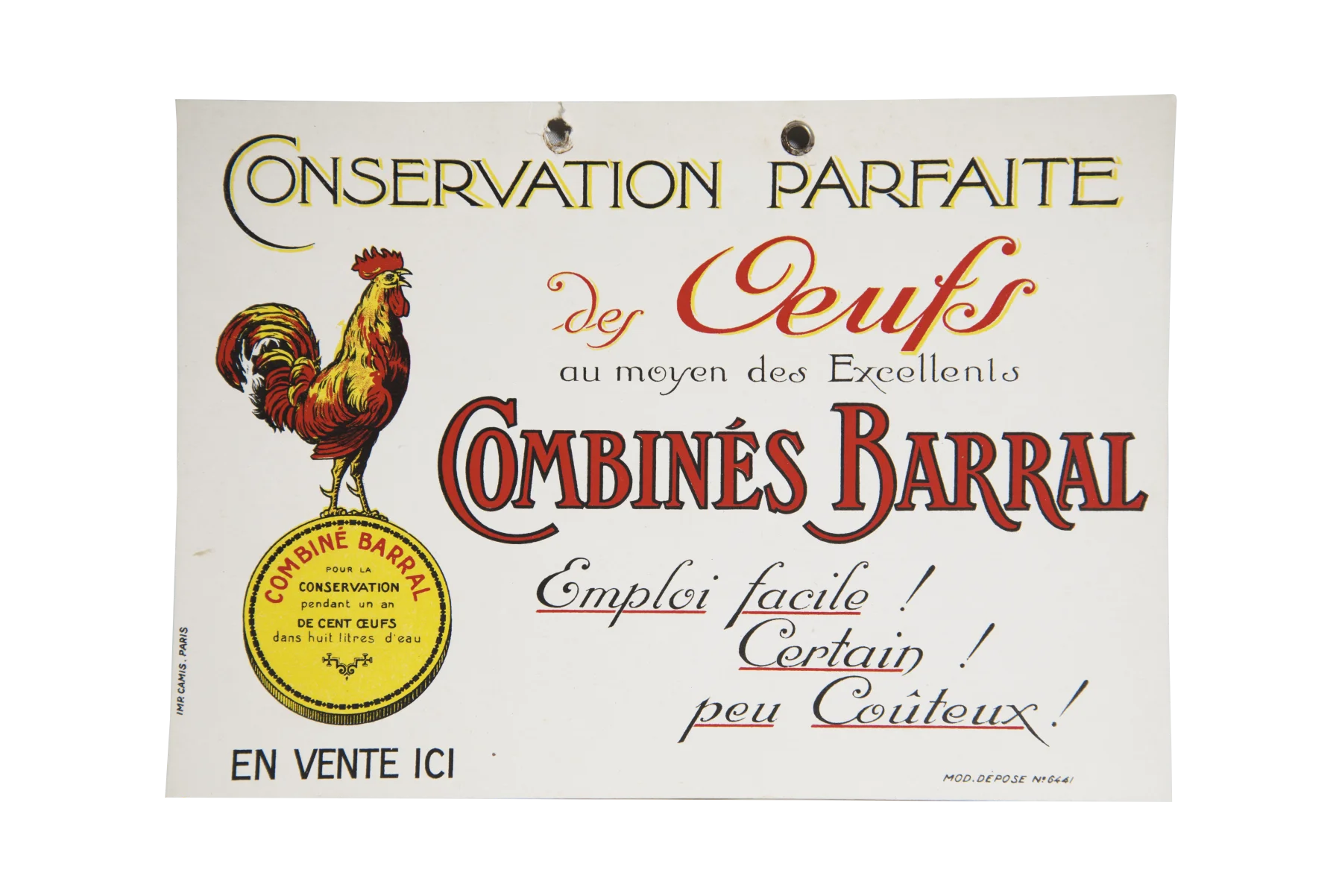
A story that follows
the rhythm of the seasons.
Before the refrigerator became common equipment, storing eggs was a daily concern. When the hens laid more eggs, we tried to set aside part of the harvest for less generous periods.
It is this need that the old advertisements for L’Ovidol and Combinés Barral respond to. They talk about provisions, household economics and the eggs that will be found on the table in winter.
1901
Originally, the name
by Jacques Barral.
A prospectus kept in our collection dates back to 1901 the discovery of Combiné Barral by the chemist Jacques Barral. The product comes in the form of dissolving discs, sold individually or in packs of five.
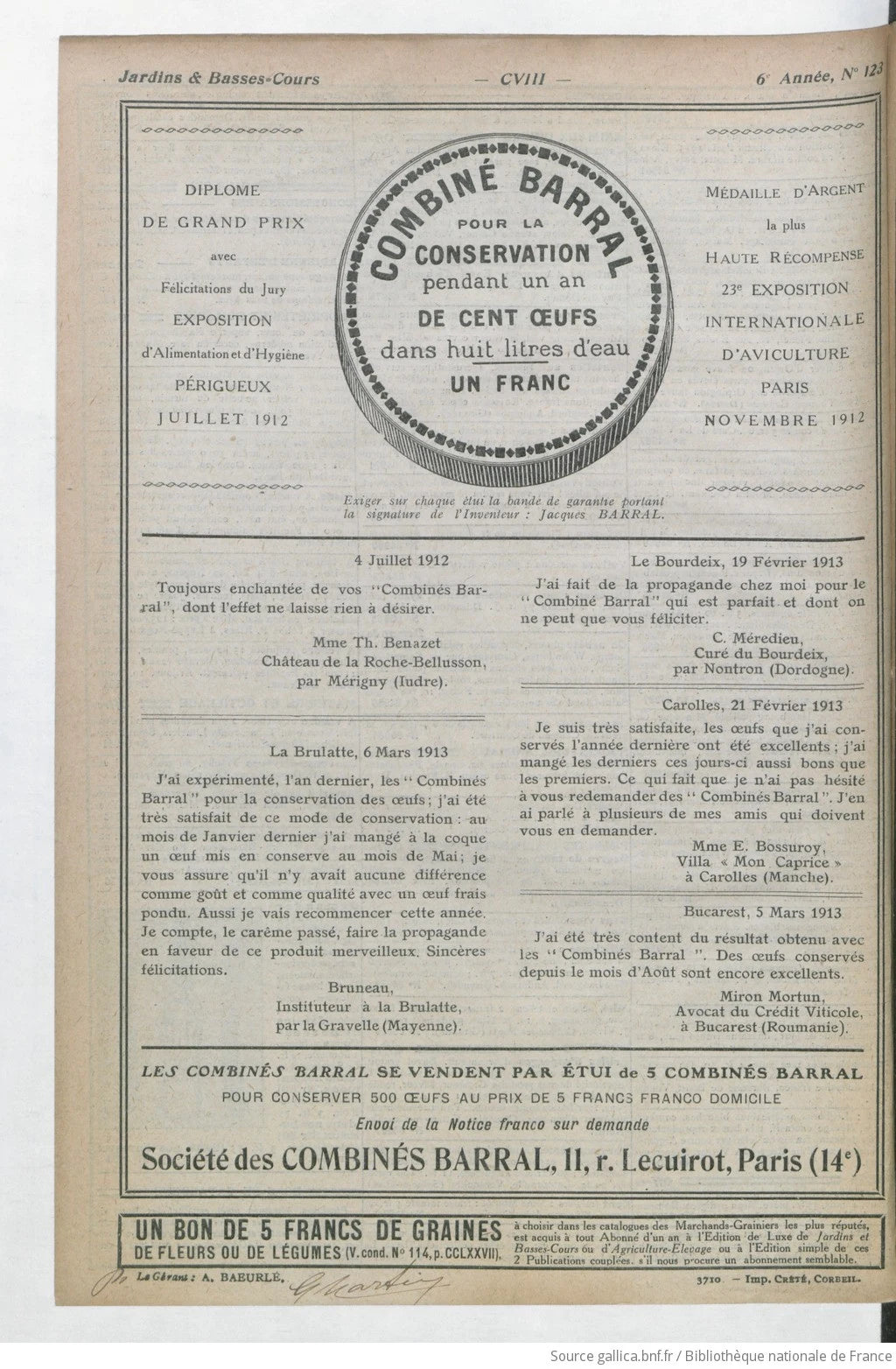
His name is found in the press of the time. In 1913, an advertisement for Gardens and backyards invites buyers to check the signature of “The Inventor: Jacques Barral” on the case. The company gives its address: 11, rue Lecuirot, in the 14th arrondissement of Paris.
From March 11, 1911, the review Nature already cited the product at this same address in its reader response section, under the spelling “combinus Barral”.
1901 is the date given by the prospectus, itself undated. The publications of 1911 and 1913 provide dated and verifiable benchmarks.
1911
L’Ovidol makes its place
from Lyon.
On April 2, 1911, The Courier of Saône-et-Loire publishes an ad for L’Ovidol. It offers a trial container for 120 eggs, at a price of 1.60 francs, and bears the name of Vattebled et Cie, Place de la Bourse, in Lyon. The house is also looking for representatives.
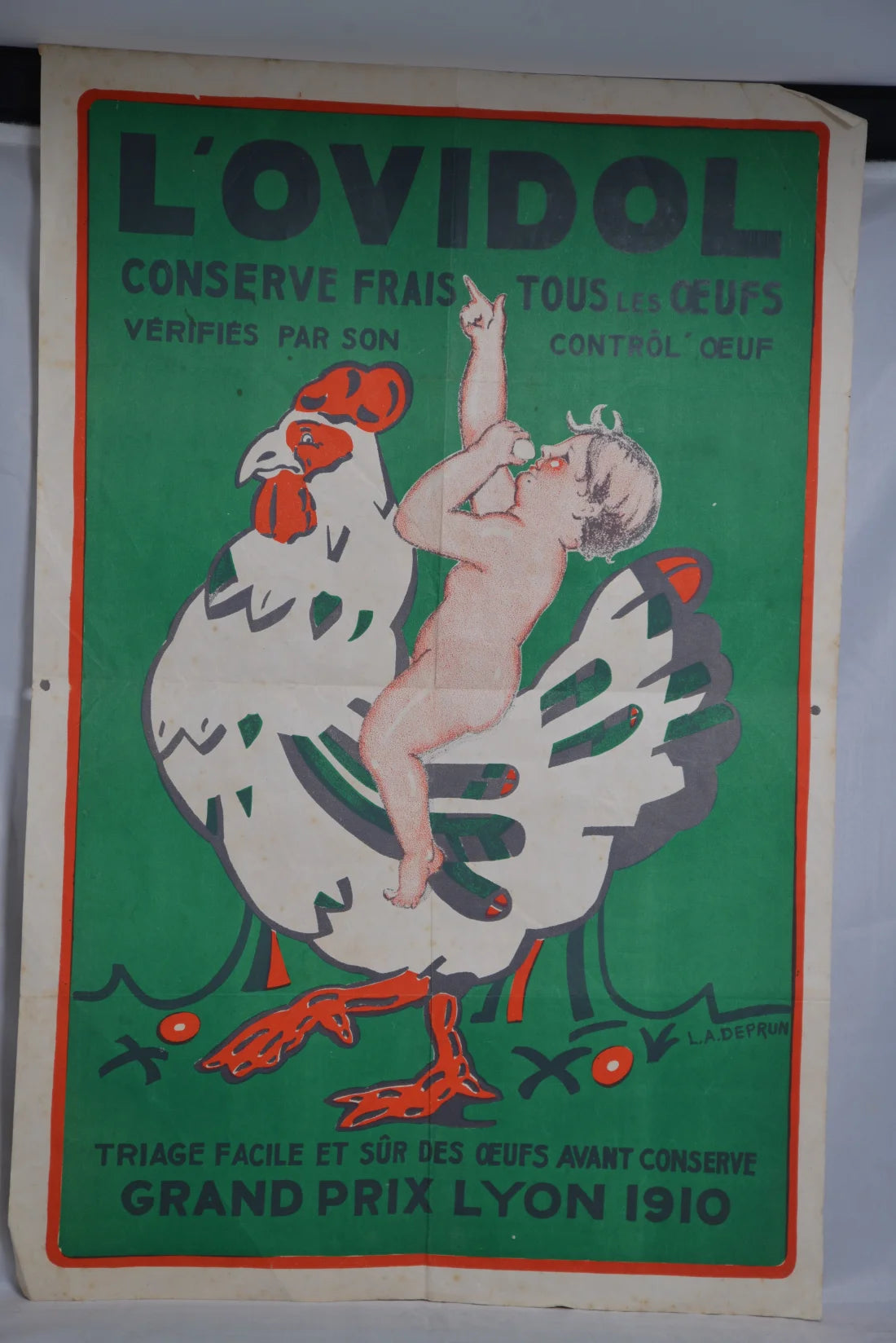
L’Ovidol already has its own universe. On the poster of our collection: a green background, a large white hen, a child and red eggs. The signature is that of L. A. Deprun. The “Egg Control” accompanies the product to sort the eggs before canning.
The poster reads “Grand Prix Lyon 1910”. This mention designates a claimed reward; it does not date either the printing of the poster or the creation of the brand.
1914–1916
From Paris to Montreal
and Spain.
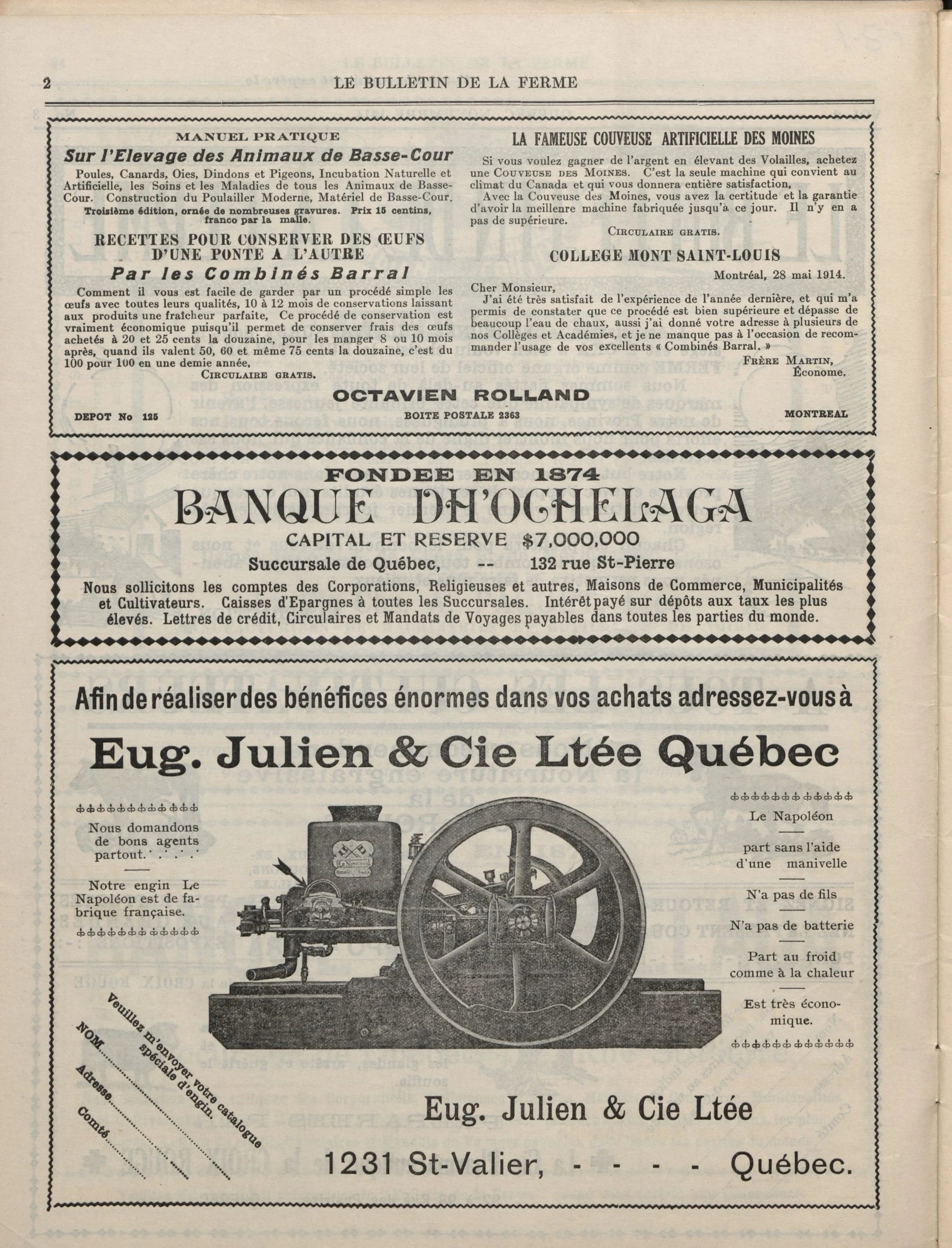
From July 1914, the Combinés Barral were announced in The Canadian Grocer. In November, an advertisement from Farm newsletter gives the name of their distributor in Montreal: Octavien Rolland. The ad even reproduces a letter from Mont Saint-Louis college discussing its experience with the product.
In March 1916, the Spanish review La Avicultura Práctica devotes several pages to them. She describes the records, cites the Société Anonyme des Combinés Barral in Paris and indicates that the Granja Paraíso, in Arenys de Mar, ensures their representation in Spain. The “Combinados Barral” have crossed borders.
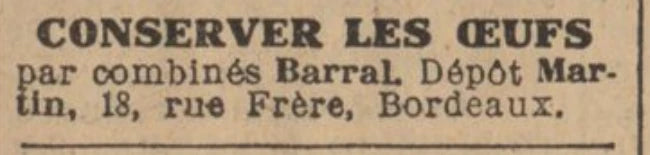
In France, local depositaries are taking over. On March 22, 1916, Little Gironde points out the Martin depot, at 18, rue Frère, in Bordeaux.
1928
Two names, two addresses.
A page from Didot-Bottin from 1928 allows you to see the two brands side by side. The Combinés Barral are associated with P. Rivier, at 8, villa d’Alésia, in Paris. L’Ovidol announces a factory in Virieu-le-Grand, in Ain, and a Parisian address at 9, Cité Universitaire.
The L’Ovidol ad includes the 1910 Grand Prix de Lyon and a medal from the Concours Lépine. In April 1930, The Woman in the Country mentions the Virieu-le-Grand factory again: customers can go there if they cannot find the product at their pharmacist or druggist.
Compare the two 1928 ads1929–1935
The Rivier years.
The announcements also allow you to track the names of the leaders. In 1929, Paul Rivier was introduced as director of the Société des Combinés Barral. In March 1935, Science and Life names Pierre Rivier as manufacturer, still at 8, villa d’Alésia.
The customer can order by money order or request a prospectus. The case of five discs, advertised for 500 eggs, is priced at 11 francs. A whole little advertising world unfolds around the product, designed to enter the home and stay there.
See the 1935 announcementWhen advertising
became a game.
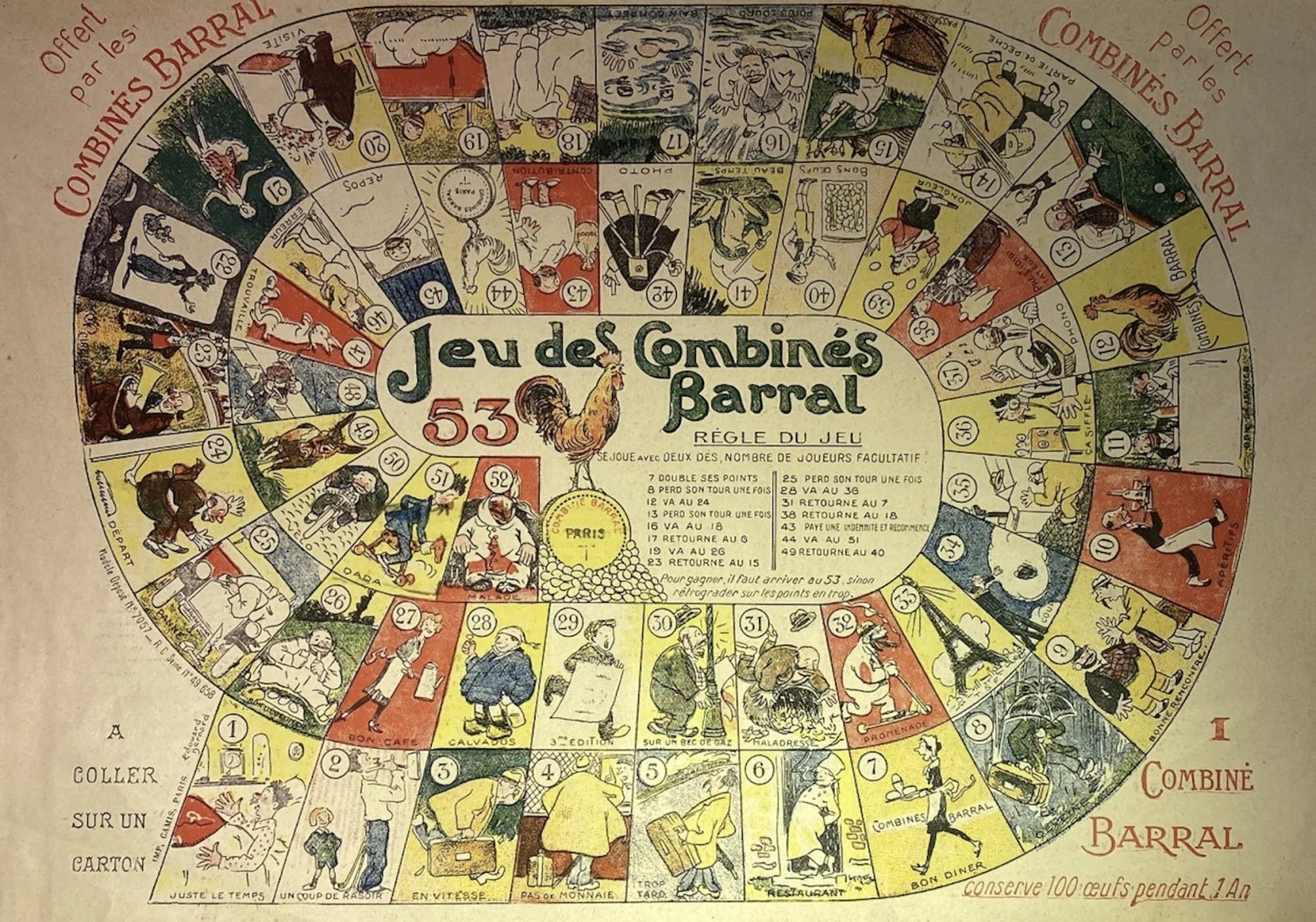
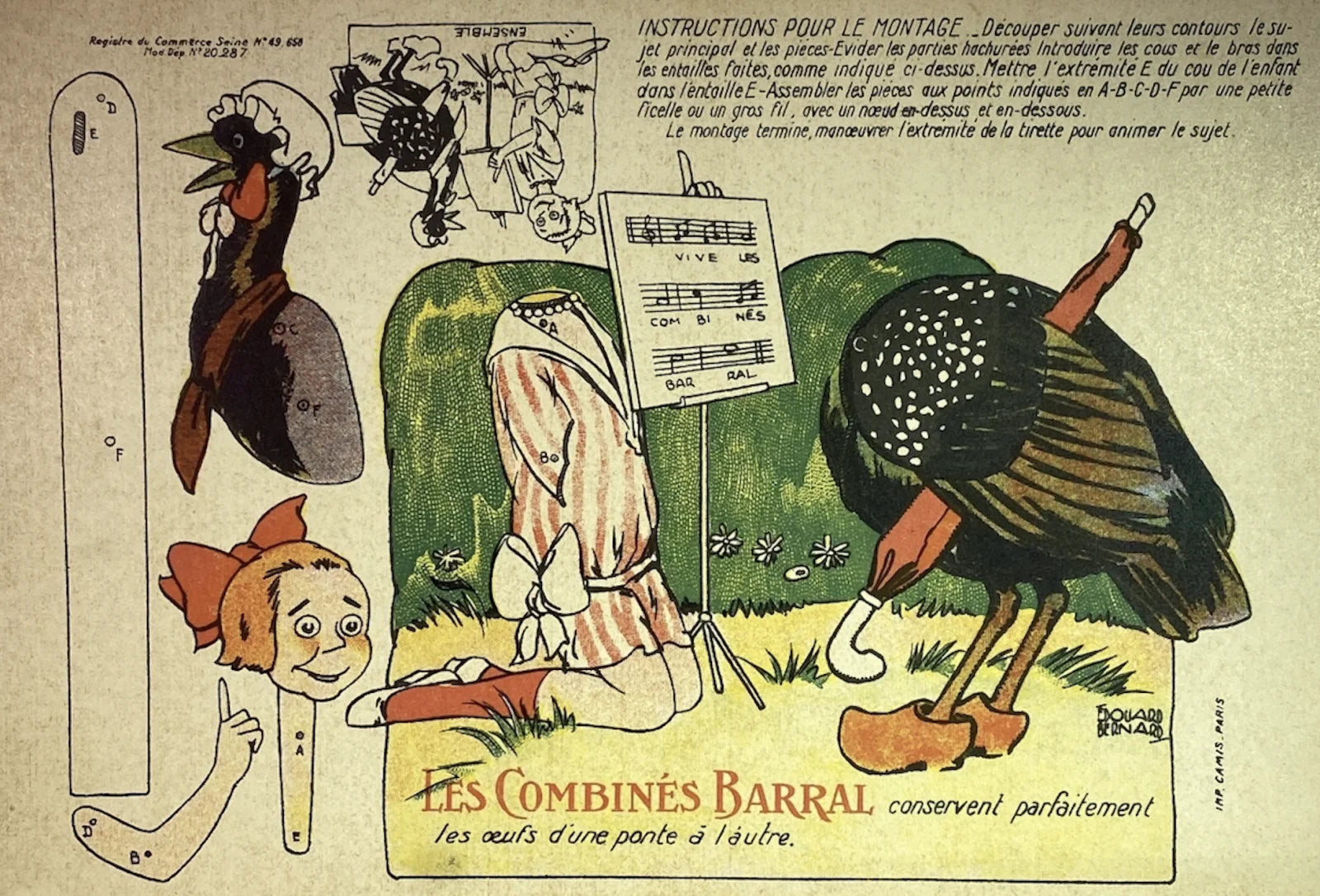
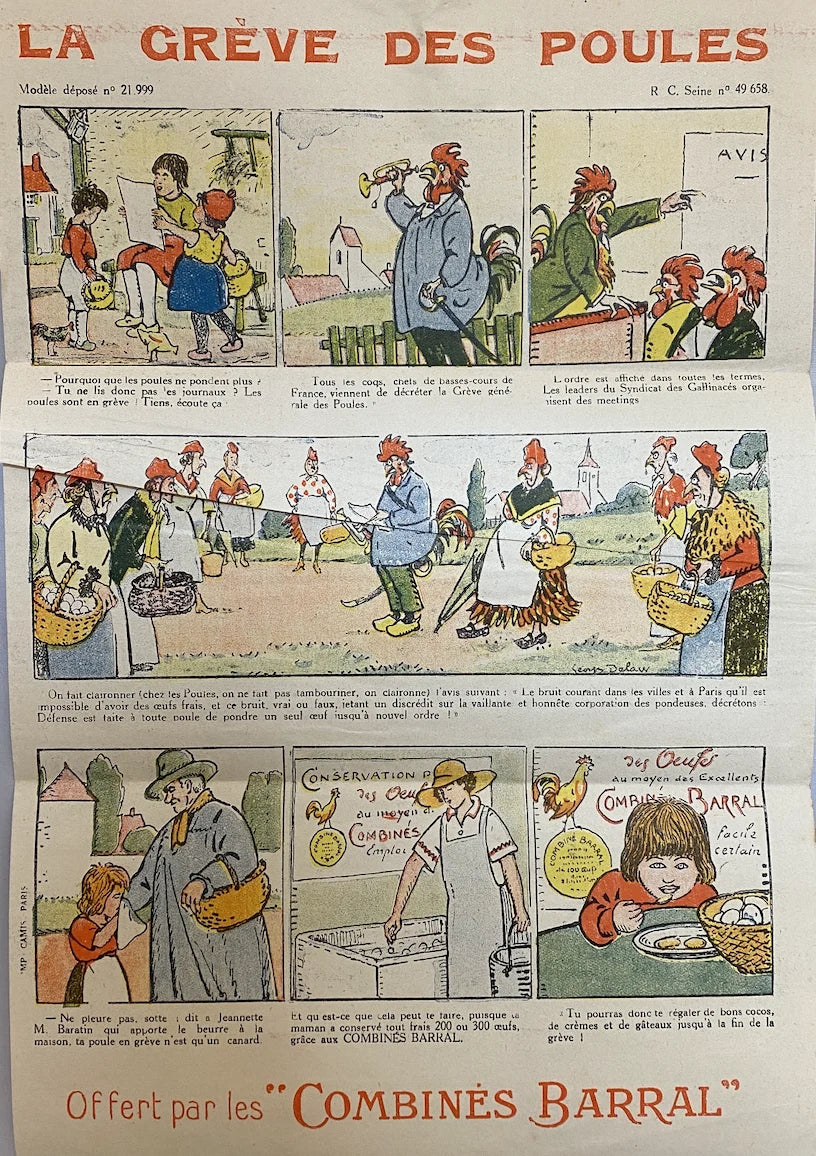
The Combinés Barral were not content with posters. The brand offered games, cut-out characters and picture stories. The rooster left the box to enter the leisure time of the house.
A Combinés Barral game is listed “around 1936” in René Poirier’s inventory of goose games. Our copy bears the words “3rd edition” and the Seine commercial register number 49.658, which can be found in Rivier’s advertisements. Its precise date remains to be established.
The Chicken Strike
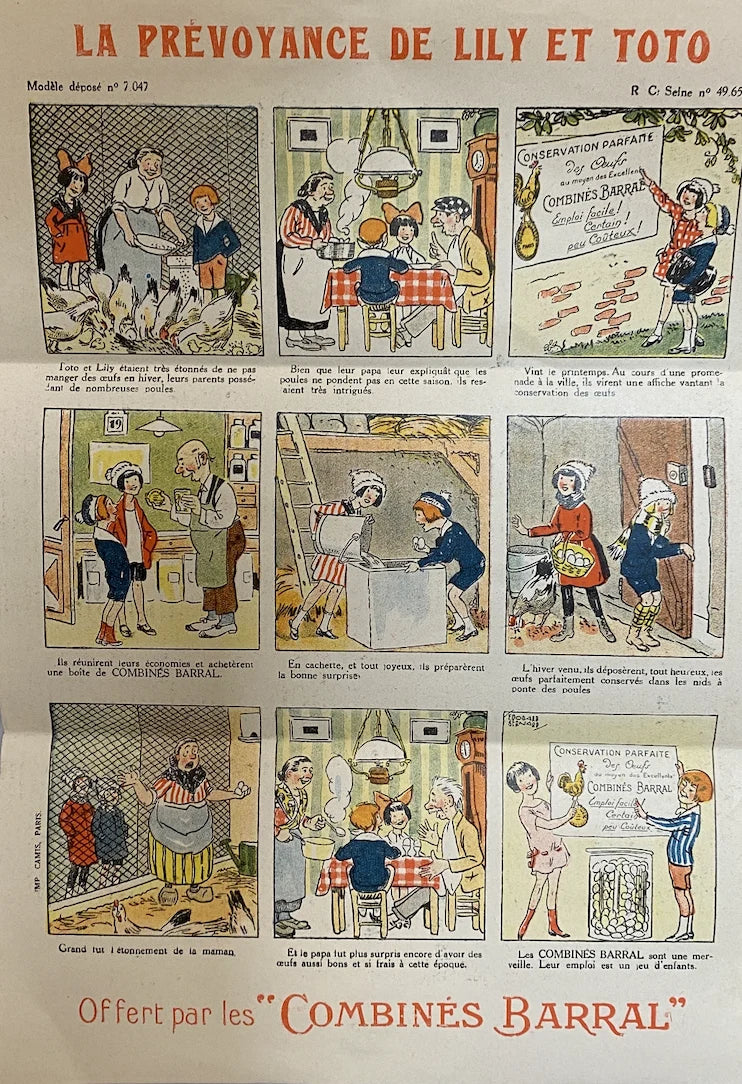
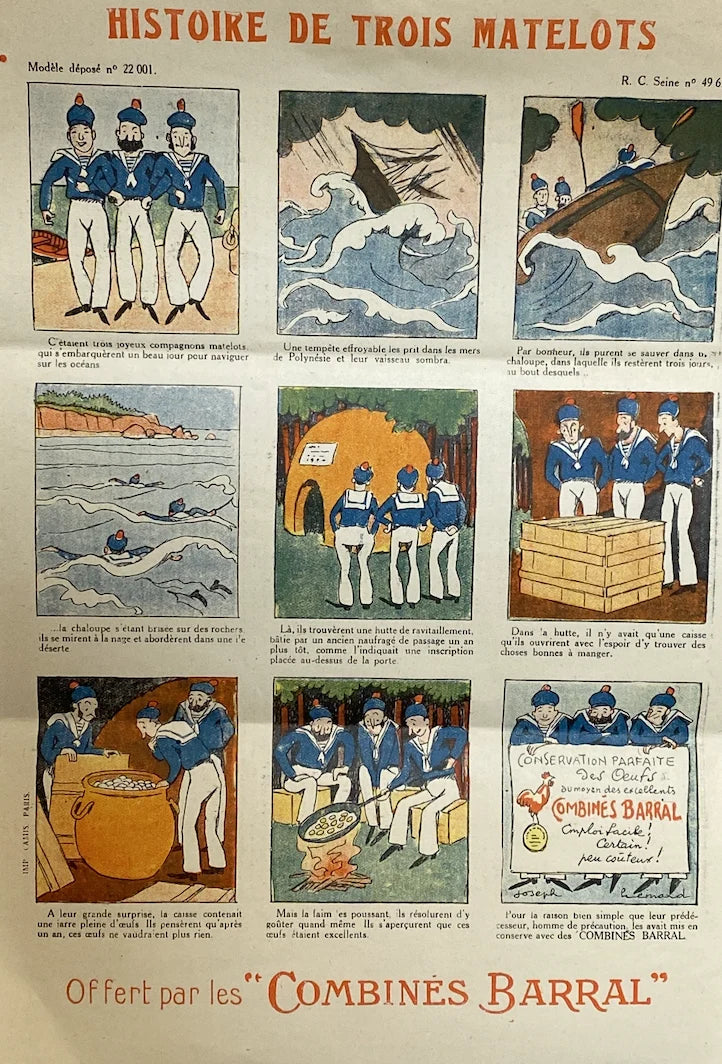
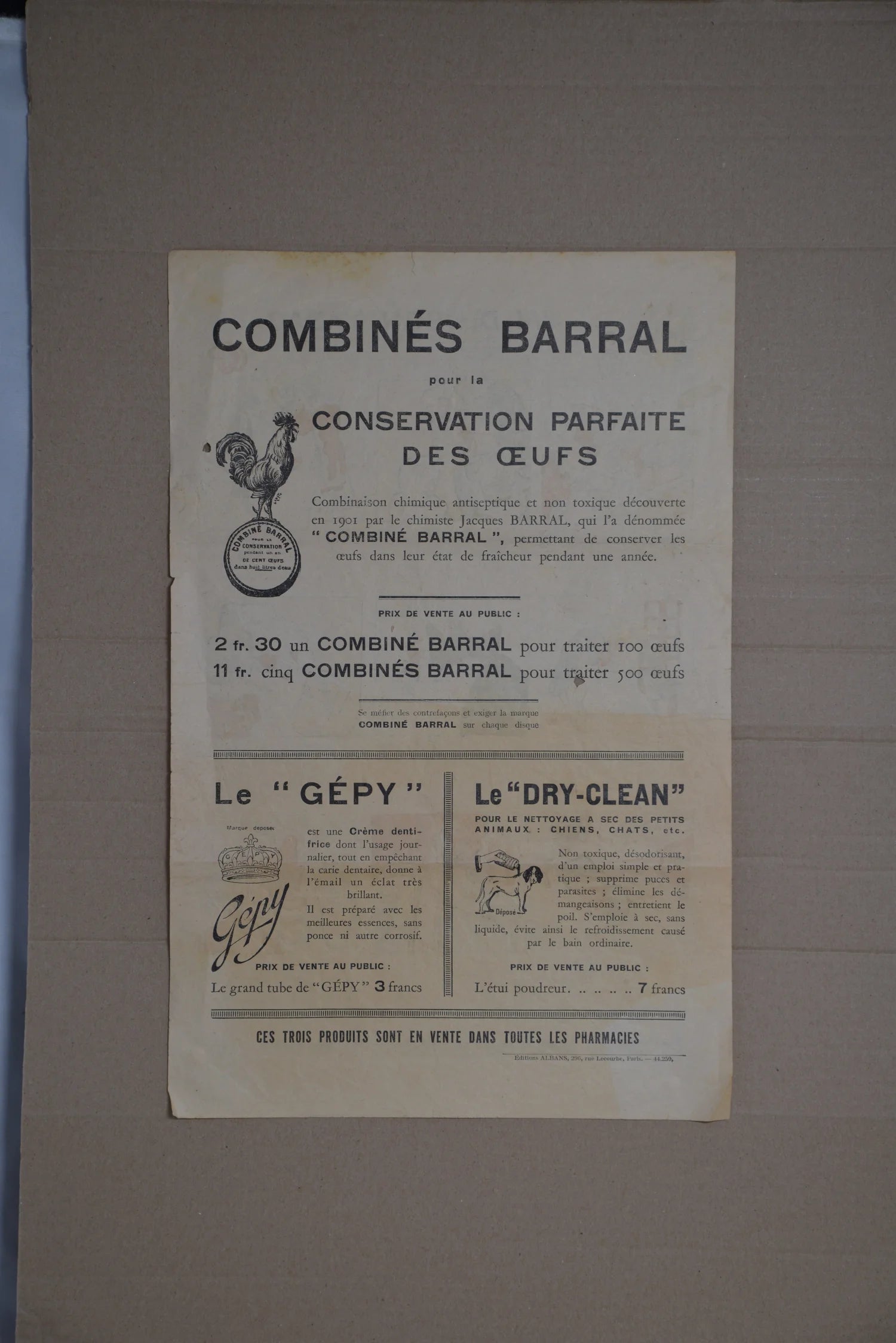
Period documents from the L’Ovidol collection. Click on the images to explore them. For current product usage, see instructions for use.
1941
A letter recounts the years of shortage.
On May 14, 1941, Pierre Rivier wrote to a pharmacist in Rouillé, in Vienne. The header reads “Society of Combinés Barral” and “Pierre Rivier successor”. But this time, it's not about praising the product: the letter explains that the necessary raw materials are missing and that no restocking is planned for the year.
This letter, found among collection documents, reveals another reality of the brand: that of an activity subject to the difficulties of its time, with its pharmacists, its wholesalers and its customers waiting.
See the photographed letter1958
L’Ovidol in the farmyard section.
In the spring of 1958, L’Ovidol appeared in the general Vilmorin-Andrieux catalog. In the section dedicated to the protection of the barnyard, a case for 100 eggs is offered at 75 francs. The name thus joins the world of seeds, gardens and family breeding.
From pharmacies to gardening catalogs, the documents tell of the different paths by which the product reached its users.
Browse the 1958 catalog, page 89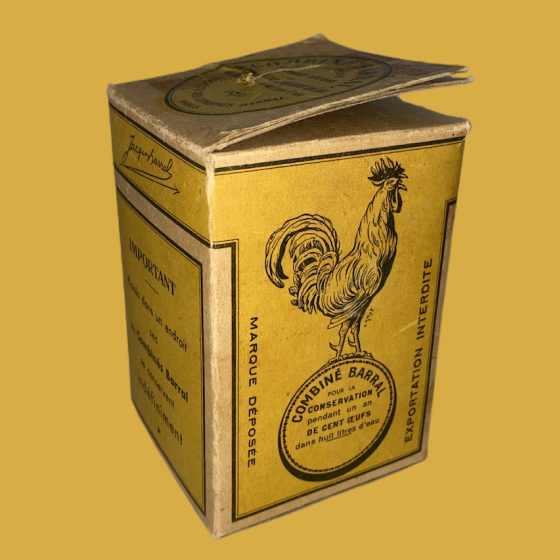
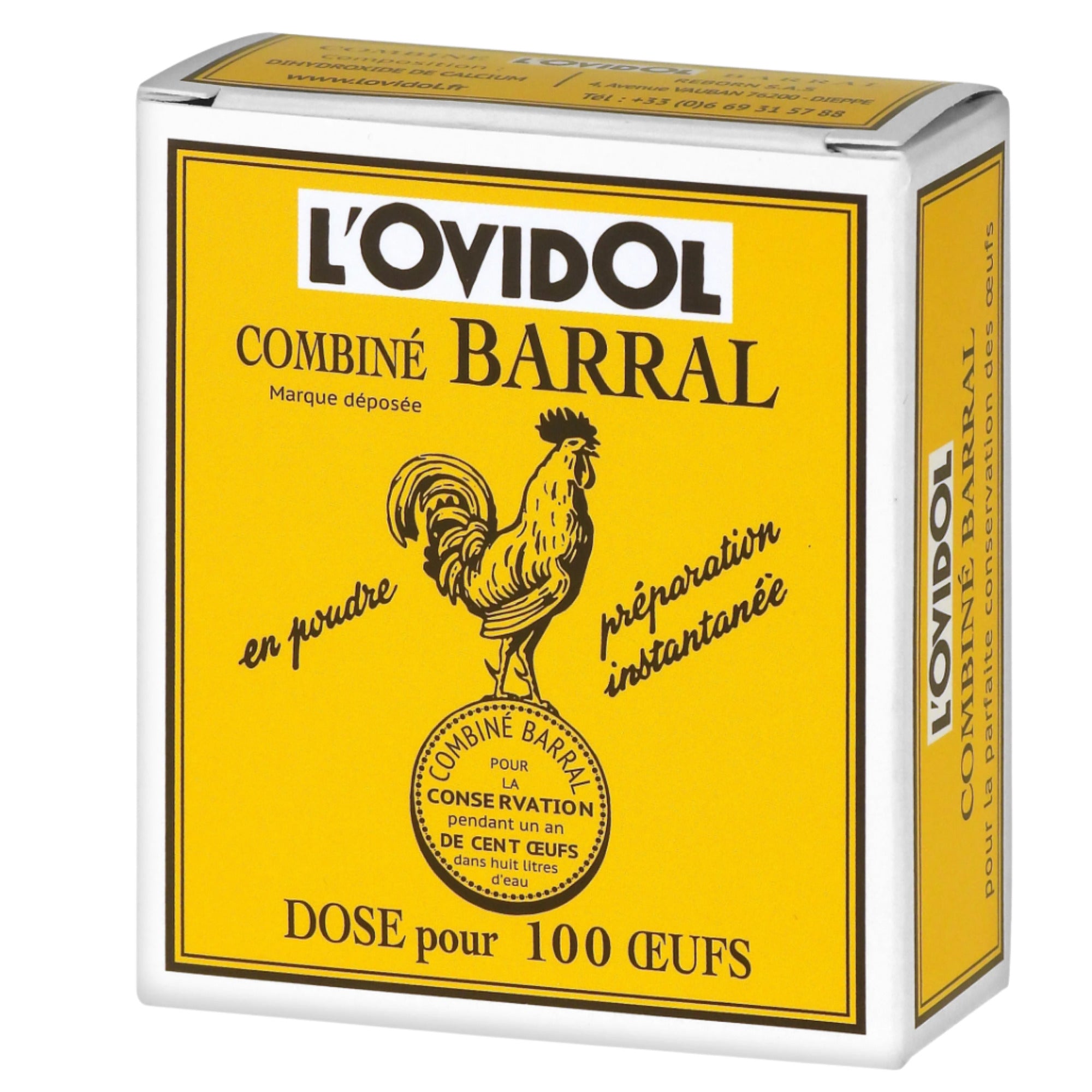
An old packaging of Combinés Barral.
Two names.
The same box.
Old posters and the 1928 directory keep traces of two commercial identities. They are then reunited: L’Ovidol and Combiné Barral appear on the same box. The name, the rooster and the yolk connect the current product to these archives.
The 2017 transmission contract already names the product “L’Ovidol combined Barral”. It makes it possible to identify the owner of the brand before Reborn: the Naudet-Dourde company.
The date and terms of the initial merger of the two brands remain to be documented. The pieces found do not yet allow us to tell of a precise redemption between them.
2017 — Today
The story continues
with Reborn.
On July 25, 2017, in Dieppe, Naudet-Dourde brought to Reborn the brand “L’OVIDOL BARRAL”, with its name, logo and graphic charter. This act, filed with the registry in September, marks the start of a new chapter.
Today, we bring L’Ovidol to life while also preserving the traces of his journey. A photographed poster, a forgotten ad, a set of paper: each of these objects helps us find the story behind the little box.
The sources of this story
This story was reconstructed from our collection, the French, Canadian and Spanish press, commercial directories, catalogs and company documents. Dated pieces are distinguished from memorabilia and dates claimed by advertisements. The promises made at the time do not constitute the current instructions for use of the product.
- 1901, according to the house archives. Flyer Combinés Barral, L’Ovidol collection, undated. He attributes the discovery to Jacques Barral in 1901; no founding act from this year has been identified.
- Barral attested in 1911. La Nature, n° 1972, March 11, 1911, supplement, p. 118, “Mailbox” (Digital Conservatory of Arts and Crafts). Mention of the “combinus Barral”, 11, rue Lecuirot.
- Jacques Barral appointed in 1913. Gardens and farmyards, 1913, n° 123, p. CVIII, view 243 (Gallica / BnF). Advertisement requesting the signature of the inventor on the case. His civil status and his parentage are not established by this document.
- L’Ovidol in Lyon in 1911. Le Courrier de Saône-et-Loire, April 2, 1911, view 3 (Gallica). Announcement Vattebled et Cie; it attests to a commercial contact, without identifying the founder of the brand.
- The poster and the mention of 1910. Poster signed L. A. Deprun, L’Ovidol collection, undated. The 1910 Grand Prix Lyon is also claimed in the 1928 Didot-Bottin; the original list remains to be found.
- Broadcast in Canada in 1914. The Canadian Grocer, July 3, 1914, p. 62 ; The Farm Bulletin, vol. 2, no. 3, November 1914, p. 2 (Canadiana). Octavien Rolland, Montreal. The testimonial reproduced in the advertisement remains a commercial testimonial.
- France and Spain in 1916. La Petite Gironde, March 22, 1916, p. 4 (The Contemporary, L’Argonnaute); La Avicultura Práctica, March 1916, p. 31–33 (Autonomous University of Barcelona).
- Two separate announcements in 1928. Didot-Bottin trade directory, 1928, volume 1, p. 1184, view 1240 (Gallica / BnF). Combinés Barral in Paris; L’Ovidol in Virieu-le-Grand and Paris. The factory is still mentioned in La Femme à la campagne, April 1, 1930, p. 75.
- Rivier names. Almanac de l’Action française, 1929, p. 290 : advertisement naming Paul Rivier. Science and Life, n° 213, March 1935, advertising page : Pierre Rivier (Cnum). No family connection between them is established here.
- The game listed around 1936. René Poirier, Iconography of the goose games (1638–1950), p. 227 (view 31 of the PDF). This dating does not apply to all advertising documents.
- The shortage of 1941. Letter from Pierre Rivier dated May 14, 1941, document photographed in a collection announcement. The text establishes a lack of raw materials and stock; it does not prove a definitive closure.
- The memory of everyday life. Micheline Lanoote, A century of Frouville life 1920–2020, bulletin n° 36 of Sauvegarde Vexin Sausseron, p. 86. Retrospective memory of the Occupation.
- The 1958 catalog. Vilmorin-Andrieux, General catalogue, spring 1958, p. 89, section “Protection of the farmyard”; digitized copy kept by Le Potager de mes rêve.
- The transmission to Reborn. Constitutive documents of Reborn, filing of September 11, 2017, contribution contract, pages 23–25 of the PDF. Signed on July 25, 2017 between Naudet-Dourde and Reborn. It concerns the brand, its name, its logo and its graphic charter; it does not date the earlier connection of the two names.
Research and cross-checking: November 2026. The photographed posters, games and stories in images belong to the L’Ovidol collection; press reproductions bear their own provenance.